"My nose is low and my nostrils are wide. Which surgery fits?"
"Silicone or my own tissue: which is better?"
"Can I get a nose that looks natural?"
These are the questions patients most often ask us about rhinoplasty. If you are searching for Korean rhinoplasty, or rhinoplasty in Korea more generally, you probably have a few more. How long does the trip need to be? When is it reasonable to fly home? And how do you compare clinics when you can't visit them first?
This guide is worth reading before you book a flight, because the plan for a nose depends on several choices that are made together, and the length of your stay follows from them.
By the end you will know:
- how rhinoplasty differs from a nose thread lift, and which one matches your goal
- the three types of surgery we offer and who each suits
- how silicone, AlloDerm, Gore-Tex and your own tissue are chosen
- the recovery timeline and how long to stay in Seoul
- the risks to discuss honestly, and what to ask any clinic
Who is behind this guide
This guide comes from the team at LAHYEON Plastic Surgery in Cheongdam, Seoul. Our doctors include Dr. Koo Bon-jun, a board-certified plastic surgeon and member of the Korean Society of Plastic & Reconstructive Surgeons, and board-certified general surgeons Dr. Im Jung-woo, our representative director, and Dr. Kim Il-gon. Each doctor's credentials are on our doctors page.
We wrote this so you can arrive at a consultation already knowing which decisions are on the table.
Surgery or a nose thread lift?
Start here, because the two are often searched together and they do very different jobs.
Rhinoplasty is surgery. It changes the structure of the nose by working on the bridge, the tip cartilage or both. A nose thread lift with Y-Nose uses PDO threads, filler or both, injected under local anesthesia, with no incision. Here is how they compare in our own information:
| Rhinoplasty | Y-Nose | |
|---|---|---|
| Method | Incision | Injection, no incision |
| Time | 2–3 hours | 15–30 minutes |
| Anesthesia | General anesthesia or sedation | Local anesthesia |
| Recovery | Stitches out day 5–7, daily life in 1–2 weeks, settling over 3–6 months | Mild swelling and bruising, fading within a few days |
| How long it lasts | Designed as a long-term structural change | Filler about 6–12 months, threads about 12–18 months |
If you want a modest change, or you only have a few days in Seoul, read the Y-Nose guide first. If you want a larger change in height or in the structure of the tip, injections have limits and surgery is usually the conversation to have.
What are the options?
Our rhinoplasty is planned as one of three types. You can see more detail on the rhinoplasty treatment page.
Bridge augmentation raises a low dorsum and adds depth to the face. It tends to suit people whose main concern is that the face looks flat from the front and the side.
Tip surgery suits a rounded or wide tip. The tip cartilage is brought together, then harvested cartilage or an artificial material is grafted on top to shape it.
Combined rhinoplasty treats the bridge and tip in one operation. For a low bridge with large, low nostrils, the tip is lifted, the tip cartilage is brought together, and your own septal cartilage is grafted on top to shape the overall silhouette.
How the plan is decided
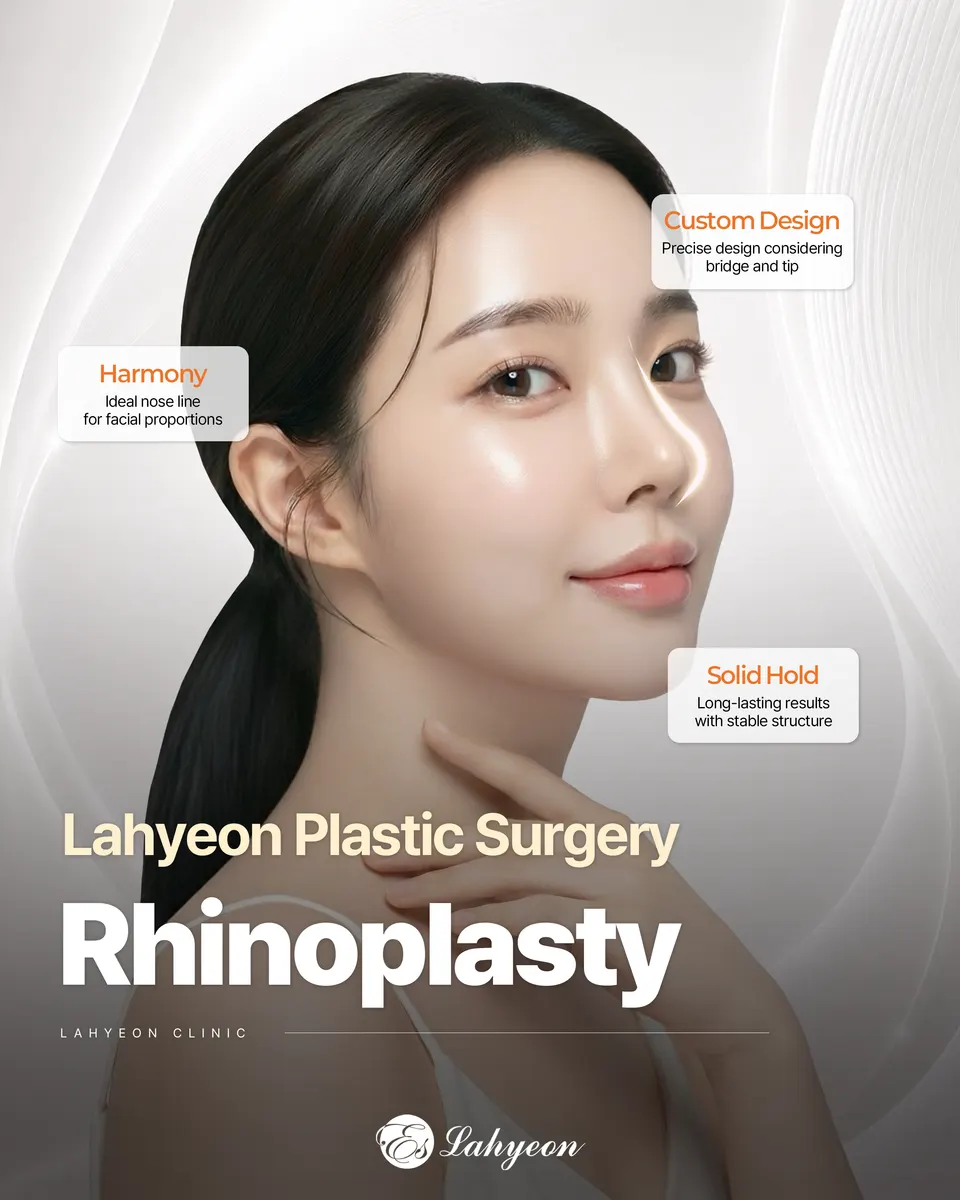
The nose sits in the center of the face, so we don't shape it on its own. The doctor looks at its balance with the eyes, cheeks and chin, then decides how much height and what tip shape make sense for that face. A bridge that looks right in a reference photo can look too strong on a different face.
Expect the consultation to cover:
- your bridge height and tip shape, and what you want changed
- the proportions of your whole face
- any previous nose surgery or injections
- which material suits your nose and your goal
- your dates in Seoul
The aim we work toward is a line that does not look operated on. Bringing a photo is useful for showing what you like, as long as you treat it as a direction and leave room for your own face.
Is Rhinoplasty right for you?
Tap what applies. We turn it into an inquiry, and our team replies with suggested next steps for your trip.
Hello, I'm interested in Rhinoplasty at LAHYEON Plastic Surgery. Could you suggest a plan for me?
No booking until you confirm.
Silicone, AlloDerm, Gore-Tex or your own tissue?
There is no material that is right for everyone. Each has trade-offs, and the choice is made after your nose is examined.
| Material | Where it is used | What to know |
|---|---|---|
| Silicone | Mainly the bridge | The longest-used nasal implant. It can be shaped precisely and does not get absorbed. |
| AlloDerm | Cartilage substitute, tip correction | A processed tissue material that feels softer than cartilage. |
| Gore-Tex | Used only when needed | Softer to the touch than silicone. |
| Septal cartilage (yours) | Tip, columella, lengthening | Taken from the wall between the nostrils. |
| Dermis (yours) | Reinforcing skin or contour in revision | Often used in revision surgery. |
| Fat (yours) | Bridge | A natural feel with little foreign-body sensation. Some grafted fat is normally absorbed by the body, so the volume can change. |
In short, silicone allows a precise and long-lasting shape, while your own tissue feels less foreign. Some noses do well with a combination, such as an implant on the bridge and cartilage at the tip. Ask why a material is being suggested for your nose in particular.
Recovery timeline
These are the figures we give for rhinoplasty. Recovery varies by person and by the extent of surgery.
| Time after surgery | What to expect |
|---|---|
| Days 5–7 | Stitches are removed at the clinic. |
| Weeks 1–2 | Most people return to daily life. |
| Months 3–6 | The nose settles and gradually looks more natural. |
Daily life and final shape are two different milestones. Swelling can still be visible when you are back at work, and the early shape is not the result you will judge the surgery by.
How long should you stay in Korea?
Plan to stay in Seoul at least until your stitches come out, on day 5 to 7. We confirm your exact schedule at consultation.
A few things make the trip easier to plan:
- Arrive early enough for an in-person consultation before surgery. Your surgery date is agreed with us.
- Count forward from your surgery date. We are closed on Sundays and close at 16:00 on Saturdays, so stitch removal needs to land on an open day.
- Book your return for after stitch removal, with some margin rather than the same evening.
- If you are having sedation or general anesthesia, arrange for someone to accompany you afterward, or ask us what to plan.
If you need to be presentable straight after the trip, tell us when you message us. A longer stay may suit you better than the minimum.
Flying home
Fly only after your stitches are out and the doctor has checked your nose. Ask at that visit whether there is anything specific to avoid on the flight, and take your aftercare instructions with you.
Aftercare at home
Follow the instructions you receive at the clinic for your particular surgery. Expect the shape to keep changing for months. If something worries you, send us clear photos and tell us how many days it has been since surgery.
You will receive detailed preparation instructions individually at consultation, including what to do about smoking, alcohol and medicines that affect blood circulation.
Risks to discuss honestly
Rhinoplasty is surgery, and every operation carries risk. The doctor examines your nose and chooses a material and method to keep that risk low, but it cannot be removed entirely. Issues that can occur after rhinoplasty in general include infection, bleeding, asymmetry, an implant shifting or becoming visible, and a shape you are unhappy with, which may lead to revision.
Results vary by person. We don't have before-and-after photos of nose surgery to show on this site, so please judge us on how clearly we answer your questions.
What does rhinoplasty in Korea cost?
We are not quoting a figure here. The price follows the plan, mainly:
- whether surgery covers the bridge, the tip or both
- which materials are used, including whether your own tissue is harvested
- whether it is a first surgery or a revision
Send us your goal and your dates and we will come back with a plan and a quote before you book a flight.
Questions to ask any clinic
- Which doctor does the consultation, the surgery and the follow-up?
- What are that doctor's specialty and training?
- Which material do you suggest for my nose, and why that one?
- What anesthesia will I have, and who monitors it?
- Will I have a splint, tape or packing, and when does each come off?
- What happens if I have a problem after I am back home?
- If my goal could be reached without surgery, will you tell me?